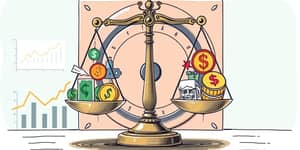

In today’s fast-paced markets, uncovering true value becomes an art form. Savvy investors learn to look beyond surface prices and recognize opportunities where others see only noise.
By mastering the principles of undervaluation, individuals and institutions alike can build lasting wealth and resilience against market swings.
Definition and Overview
At its core, an undervalued asset trades at a price below its intrinsic worth. Intrinsic value represents the true calculated economic worth of an investment based on fundamentals rather than market sentiment.
When the market price falls short of intrinsic value, a gap appears. This gap offers investors the chance to buy when market price < intrinsic value and realize gains when prices converge with underlying worth.
Consider a stock trading at $50 per share. Through a discounted cash flow analysis, an investor estimates its intrinsic value at $75. That $25 difference illustrates a potential profit if the market corrects the mispricing.
Why Undervaluation Happens
- Market inefficiencies: Short-term news and crises can trigger overreactions that misprice securities.
- Analyst coverage gaps: Lesser-known companies often slip under the radar, leaving fundamentals overlooked.
- Accounting distortions: Historical cost rules can leave assets like land recorded far below current market rates.
Economic downturns, sector rotations, or sudden regulatory shifts are prime catalysts. These dynamics can push solid businesses and real estate below their fundamental value.
Where to Find Undervalued Assets
Public Equities (Stocks): The classic hunting ground for value investors. Key signals include low price-to-earnings ratios versus sector averages, price-to-book ratios below one, and stocks trading beneath tangible book value.
Real Estate: Properties recorded at historic cost on balance sheets can mask massive appreciation. A notable example is McDonald’s, which still reports land purchased decades ago at original prices despite prime locations commanding far higher market values.
Private Businesses and Private Equity: Operational inefficiencies and hidden assets present opportunities. Private equity firms often restructure or spin off divisions to unlock latent value.
Brand Value: Internally built brands like Apple, Nike, or Home Depot may not appear on the balance sheet but generate significant cash flows. This omission can create hidden pockets of potential for perceptive investors.
Distressed Assets: Companies in financial distress may have tangible assets worth more than their market valuation, offering acquisition or turnaround prospects for those equipped to manage risk.
Methods for Identifying Undervalued Assets
- Discounted Cash Flow (DCF) Analysis: Projects future cash flows and discounts them at an appropriate rate to determine present value.
- Comparative Analysis: Evaluates financial multiples such as P/E, P/B, or EV/EBITDA against peers and historical benchmarks.
- Asset-Based Valuation: Assesses replacement or liquidation value of tangible and intangible assets on the balance sheet.
- Margin of Safety: Buys with a cushion to absorb errors in estimating intrinsic value.
Combining these approaches yields a robust framework. For instance, pairing DCF with comparative ratios can validate assumptions and narrow the margin of mispricing.
Practical Applications
Value investing forms the cornerstone of legends like Warren Buffett, who have demonstrated that disciplined patience and rigorous analysis can outperform during market turmoil.
Mergers and acquisitions teams scour financial statements for undervalued targets, aiming to generate synergies or restructure operations.
Real estate investors leverage market cycles, buying during downturns and selling when demand rebounds. Applying built-in margin of safety principles mitigates risks from unforeseen costs or delays.
Risks and Criticisms
Despite its appeal, value investing is not without pitfalls. Value traps occur when assets remain undervalued due to genuine structural decline or obsolescence.
Errors in forecasting cash flows, discount rates, or growth trajectories can lead to persistent underperformance.
Furthermore, markets may take extended periods—sometimes years—to recognize intrinsic value, resulting in dead money periods with little price movement.
Accounting distortions, especially around intangibles, can skew ratios such as Price/Book or ROE, demanding careful scrutiny of footnotes and valuation assumptions.
Numbers, Metrics, and Real-World Examples
In 2025, the median P/E ratio for S&P 500 constituents hovered near 22, compared to a long-term average of 16. Stocks trading below 15 P/E today often signal potential undervaluation.
A mid-cap firm with a book value of $100 million but a market cap of $60 million invites further investigation. If its balance sheet reveals land worth $50 million at historic cost, true value may be vastly understated.
Emerging market equities flashed opportunities post-2023, when global interest rate hikes caused indiscriminate selloffs. Investors who applied disciplined valuation methods have since reaped double-digit returns.
Summary Table
Conclusion and Next Steps
Unlocking value requires patience, rigorous analysis, and emotional discipline. By combining DCF, comparative ratios, and asset-based approaches, investors can identify mispriced opportunities across stocks, real estate, private businesses, and intangible brands.
Start by screening for low P/E and P/B ratios, review balance sheet footnotes for hidden assets, and always maintain a margin of safety. With these tools, you can navigate volatility and build a portfolio poised to capture the hidden inverse of market inefficiency.
Remember, every market downturn carries the seed of tomorrow’s profits—equip yourself with the frameworks to spot undervaluation and transform temporary dislocations into lasting wealth.
References
- https://diversification.com/term/undervalued-assets
- https://einvestingforbeginners.com/undervalued-assets/
- https://superworks.com/glossary/undervalued-assets/
- https://en.wikipedia.org/wiki/Undervalued_stock
- https://www.deferred.com/accounting-terms/undervalued
- https://bux.com/knowledge/invest/glossary/undervalued-stocks/
- https://navi.com/blog/undervalued-stock/