
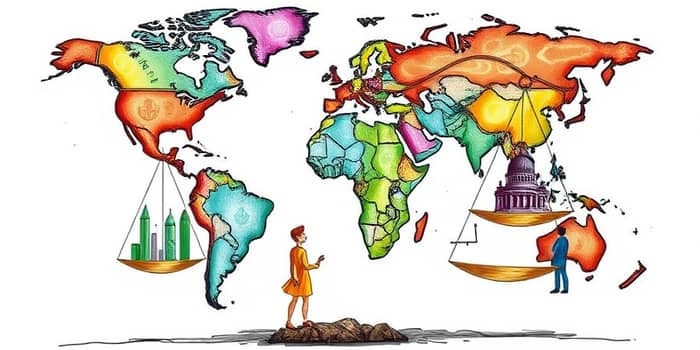
The burden of sovereign debt is not just a series of numbers on a balance sheet—it shapes the future of nations, affects social programs, and influences global stability. As governments navigate fiscal challenges, understanding the causes, risks, and solutions becomes more critical than ever before.
In this article, we explore the current landscape of sovereign debt, dissect regional trends, examine historical surges, and outline practical policy responses to ensure sustainable growth and social equity.
Global Sovereign Debt Landscape: Current Numbers & Trends
By 2025, government borrowing soared to an unprecedented level: global public debt reached $111 trillion, while combined public and private debt hit $251 trillion in 2024. The ratio of public debt to GDP climbed to 94.7% worldwide, and total debt represented 235% of world GDP. Japan, Sudan, Singapore, and China stand out with ratios exceeding 96% of GDP, underscoring diverse debt burdens.
The United States and China account for a staggering 52% of global public debt, reflecting their economic dominance but also their heightened exposure to fiscal shocks. Meanwhile, sovereign bond issuance is rising rapidly: the OECD projects $17 trillion in new bonds by 2025, up from $14 trillion in 2023.
Regional & Income Group Breakdowns
Debt trends vary significantly across regions and income levels:
Advanced economies (excluding the U.S.) carry an average public debt load of 110% of GDP. Some countries like France and the UK have seen further increases, while Greece, Portugal, and Japan have managed slight reductions in their ratios. Private debt in the United States fell by approximately five percentage points to 143% of GDP as households and firms deleveraged.
In emerging markets and developing economies (EMDEs), public debt rose from 67% to 69% of GDP between 2023 and 2024, with private debt edging up to 123%. Rising debt service costs are constraining investments in health, education, and infrastructure.
Historical Context and Debt Surges
The debt-to-GDP ratio spiked to nearly 99% in 2020 as governments responded to the COVID-19 pandemic with unprecedented fiscal packages. Total global debt momentarily reached 258% of GDP. Over the decades, the world has progressively shifted from private borrowing to public financing, a trend driven by evolving financial systems and policy priorities.
Understanding these historical peaks helps identify triggers and design stronger safety nets for future crises.
Causes of Rising Sovereign Debt
- Massive COVID-19 fiscal stimulus and health spending
- Persistent budget deficits averaging 5% of GDP
- Escalating interest payments under higher rates
- Strategic borrowing to support non-financial sectors
These factors have combined to push debt burdens higher, leaving little room for error in fiscal management.
Risks and Implications
High levels of sovereign debt pose significant challenges:
Debt sustainability concerns arise when interest costs outpace economic growth. Many EMDEs face debt servicing pressures that crowd out social spending. Sovereign credit ratings often provide only a short warning—three to six months—before crisis conditions emerge.
Defaults or sharp corrections in one country can spark global financial instability, as capital flows, trade links, and market sentiment react to contagion risks. Meanwhile, austerity measures intended to restore fiscal balance may inadvertently stifle growth and provoke social unrest.
Crisis Management & Prevention Mechanisms
Effective crisis prevention relies on transparency, robust data, and strategic planning. The IMF and World Bank advocate for medium-term debt management strategies and the development of local currency bond markets to reduce foreign exchange vulnerabilities.
- Enhancing public sector debt reporting and disclosure
- Implementing currency hedging and risk mitigation tools
- Deploying Collective Action Clauses in bond contracts
- Utilizing G20 Common Framework for restructuring
International Financial Institutions play a key role by providing financial assistance, technical guidance, and sometimes official transfers to contain spillovers.
Policy Debates & Innovative Approaches
Policymakers continue to explore creative solutions to manage sovereign debt:
Official transfers—grants or concessional loans—can alleviate immediate pressures but risk encouraging reckless borrowing, a phenomenon known as moral hazard. To address climate and disaster vulnerabilities, some countries are adopting disaster-linked debt suspension clauses that pause payments during emergencies.
There is growing interest in state-contingent bonds—such as GDP-linked or catastrophe bonds—that automatically adjust repayments based on economic or environmental triggers. The G20/Common Framework facilitates coordinated restructuring through standstills, debt swaps, and guarantees underpinned by global institutions.
Economic & Geopolitical Implications
High debt burdens limit fiscal space for investments in education, healthcare, and climate adaptation. Emerging markets often bear a disproportionate share of these constraints, exacerbating global inequality.
Major defaults can reverberate through global markets, threatening banks, funds, and trading partners. Countries heavily reliant on foreign-currency borrowing remain exposed to exchange rate shocks, which can dramatically increase their local debt loads overnight.
Lessons Learned & Best Practices
- Early engagement and prompt interventions minimize losses
- Maintaining fiscal policy consolidation efforts during growth phases
- Strengthening collective action frameworks to enable orderly restructuring
- Phasing in adjustments through gradual normalization strategies
Countries with clear debt management frameworks, strong local markets, and transparent data generally navigate shocks more effectively.
As sovereign debt continues to rise, the path forward demands a combination of responsible and transparent borrowing, international cooperation, and innovative financing mechanisms. By learning from past crises and embracing pragmatic policy tools, nations can chart a course toward debt sustainability and financial stability, safeguarding prosperity for future generations.
The global community stands at a crossroads. By prioritizing long-term fiscal resilience frameworks and fostering inclusive dialogue, policymakers, investors, and citizens can transform the debt dilemma into an opportunity for sustainable development and shared prosperity. The choices made today will resonate for decades—let them be guided by foresight, equity, and solidarity.
References
- https://www.voronoiapp.com/economy/Government-Debt-to-GDP-Around-the-World-in-2025--6978
- https://cepr.org/voxeu/columns/how-resolve-systemic-sovereign-debt-crisis
- https://www.imf.org/en/Topics/sovereign-debt/focus-areas
- https://www.imf.org/en/blogs/articles/2025/09/17/global-debt-remains-above-235-of-world-gdp
- https://www.iif.com/Products/Global-Debt-Monitor
- https://www.bu.edu/articles/2023/what-is-the-sovereign-debt-crisis-and-can-we-solve-it/
- https://www.oecd.org/en/publications/2025/03/global-debt-report-2025_bab6b51e.html
- https://worldpopulationreview.com/country-rankings/countries-by-national-debt
- https://www.visualcapitalist.com/ranked-countries-with-the-most-government-debt-in-2025/
- https://www.worldbank.org/en/programs/debt-statistics
- https://www.worldbank.org/en/publication/wdr2022/brief/chapter-5-managing-sovereign-debt
- https://www.hks.harvard.edu/publications/financial-and-sovereign-debt-crises-some-lessons-learned-and-those-forgotten
- https://www.gisreportsonline.com/r/sovereign-debt-2/