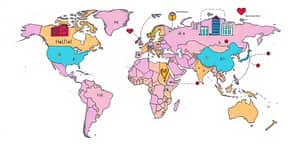

In an era where knowledge serves as the most valuable currency, the global education sector emerges as both a catalyst for individual growth and a cornerstone of economic strength. Faced with unprecedented challenges and opportunities, understanding the dynamics of education spending and human capital investment is essential for policymakers, investors, and educators alike.
The Growing Magnitude of the Global Education Market
The global education market stands as a colossus at $7.6 trillion in 2024, projected to reach $8 trillion by 2030. This vast ecosystem grows at a compound annual growth rate (CAGR) of 4.4%, driven by demographic shifts, digital innovation, and expanding demand for lifelong learning.
Market segmentation reveals that K-12 and post-secondary education command approximately 80% of total spending, underscoring their foundational role. Early childhood programs and workforce training each hold around 11–12%, reflecting the rising importance of continuous skills development across the globe.
In Asia-Pacific, government-led initiatives in China and India bolster enrollment by investing in teacher training and digital classrooms. Africa’s youthful population positions it for steep expansion but requires targeted infrastructure investments to transform potential into tangible outcomes.
In Europe and North America, advanced economies focus on curriculum innovation, vocational training, and lifelong learning, adapting to shifting labor markets and the rise of knowledge-intensive industries.
The Economics of Education Spending Worldwide
Governments invest rigorously in education, allocating 4–5% of GDP on average, while private contributions add another 2%. This public-private funding model supports diverse learning pathways and infrastructure projects, from brick-and-mortar schools to online platforms.
Take the United States: annual K-12 expenditure reaches $857.2 billion—equivalent to $17,277 per pupil—paired with $30,228 per student in public post-secondary education. At 5.59% of GDP spent on education, the U.S. exceeds the developed world average, though it still falls short of UNESCO’s 15% public expenditure benchmark.
Contrasting figures emerge globally: American Samoa invests 14.7% of its GDP in education, Kiribati dedicates 14.2%, and Cuba allocates 9.4%. These examples illustrate how even small or resource-constrained economies prioritize human capital to drive social progress and stability.
Yet many nations continue to operate below optimal funding levels, highlighting an urgent need for support in under-resourced regions where education can serve as a powerful lever for recovery and growth.
Returns on Human Capital Investment
Investing in education yields measurable returns for individuals and economies. Globally, each additional year of schooling translates to a 9% boost in hourly earnings, lifting households out of poverty and stimulating consumer markets.
On a national level, higher education attainment fuels innovation, drives research and development, and strengthens global competitiveness. Regions that prioritize human capital experience sustained economic growth, lower unemployment rates, and more robust social welfare systems.
Consider microfinance initiatives in South Asia that link small loans to conditional school attendance. These programs have generated community-wide gains in productivity and health, demonstrating the multifaceted benefits of educational investment beyond immediate economic metrics.
Driving Forces in Education Market Evolution
A convergence of factors propels change in the global education landscape, creating massive growth opportunities while challenging institutions to adapt:
- Rising private equity interest in workforce training and edtech ventures
- Technological breakthroughs fueling digital learning platforms
- Demographic shifts with emerging markets expanding enrollment rapidly
- Policy reforms targeting STEM fields and early childhood education
Advanced technologies such as AI-driven tutoring, virtual reality laboratories, and adaptive learning algorithms are reshaping pedagogical models. While these innovations promise personalized learning experiences, they also demand robust digital access and data privacy safeguards.
Overcoming Barriers to Equitable Education
Despite progress, significant hurdles remain. In crisis-affected regions, 234 million children require urgent learning support. Of the 85 million out-of-school youth, only 17% of primary-age children in conflict zones achieve minimum reading proficiency.
Addressing these disparities demands investments in teacher training, robust digital infrastructure, and community-driven initiatives. Local and international NGOs are piloting mobile libraries and teacher exchange programs to reach learners in remote and unstable contexts.
Collaborative efforts with governments ensure that displaced students receive credentials recognized across borders, preserving educational continuity and building inclusive learning environments worldwide.
Charting the Path Forward: Public-Private Partnerships and Innovation
Strategic alliances between governments, NGOs, and private investors are reshaping the educational landscape. By pooling resources, stakeholders can scale successful pilot programs, deploy advanced learning technologies, and target underserved populations more effectively.
- Implement blended finance models to de-risk investments and attract capital
- Leverage mobile and solar-powered classrooms to reach remote regions
- Establish outcome-based funding tied to measurable learning achievements
Global frameworks—such as the UNESCO Education 2030 Agenda—provide a roadmap for achieving Sustainable Development Goal 4: inclusive, equitable, quality education. By aligning national policies with international benchmarks, stakeholders can track progress, share best practices, and drive accountability.
For investors and philanthropists, channeling resources into evidence-based programs and scalable technologies can multiply impacts, ensuring that every dollar contributes to lasting improvements in learning outcomes.
Conclusion: Investing in Our Collective Future
Education is not merely a sector; it is the bedrock upon which global prosperity rests. With a $7.6 trillion market, rising private sector engagement, and clear returns on human capital, the case for investment is compelling.
By confronting equity challenges, embracing innovation, and forging cross-sector partnerships, we can unlock the potential of millions, transforming lives and economies alike. Today’s investments in education are tomorrow’s breakthroughs in health, technology, and social progress—ensuring a brighter, more just world for generations to come.
Now is the moment to act decisively. Whether through policy reform, strategic funding, or grassroots advocacy, stakeholders at all levels can play a part. By investing in education, we secure a future defined by opportunity, innovation, and the universal right to learn.
References
- https://worldpopulationreview.com/country-rankings/education-spending-by-country
- https://iscresearch.com/news-5-emerging-markets/
- https://educationdata.org/public-education-spending-statistics
- https://www.holoniq.com/notes/the-size-shape-of-the-global-education-market
- https://www.privatecapitalsolutions.com/insights/private-equity-investment-in-education-understanding-the-market
- https://www.oecd.org/en/publications/2025/09/education-at-a-glance-2025_c58fc9ae.html
- https://www.worldbank.org/en/topic/education/overview